> For the complete documentation index, see [llms.txt](https://docs.xyb.co/llms.txt). Markdown versions of documentation pages are available by appending `.md` to page URLs; this page is available as [Markdown](https://docs.xyb.co/the-platform/xyb-platform-overview.md).

# XYB Platform - Overview

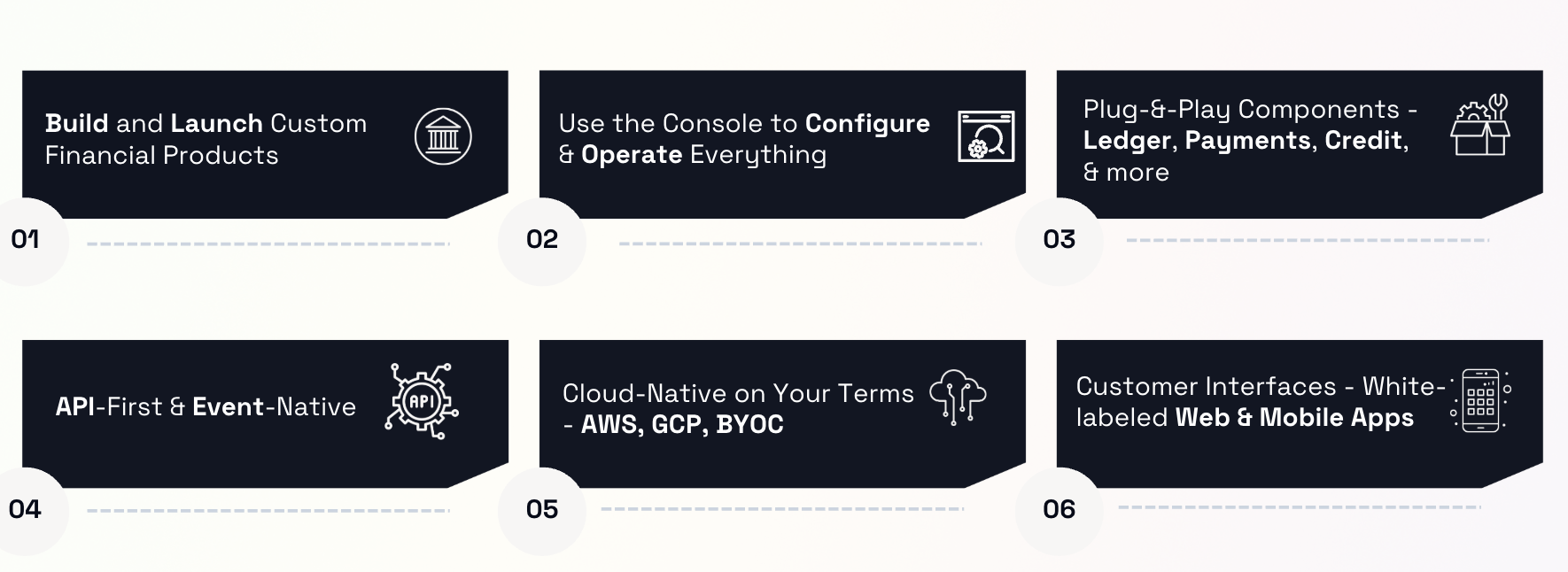
XYB is a platform for building, orchestrating, and operating financial products: deposits and wallets, payments and FX, credit, interest, and cards.It works through three layers: **Component** (the individual capabilities), **Orchestration** (the shared services those capabilities configure against), and **Experience** (how it's all surfaced to a person)each independent, connecting outward to payment rails, card networks, and identity/KYC providers through adapters.

It's made of composable components you use only as needed, not one fixed product, plus the adapters that connect them outward.With the XYB platform, you can modernise a live system, add a single new capability, or build from scratch, all on the same platform, so your starting point doesn't lock you into a different product later.

It's built for multiple personas: product managers and developers who configure products and workflows, banking operators who run day-to-day operations from the console, and the end users of the resulting white-labeled apps.

<table><thead><tr><th width="290.9296875">Your situation</th><th>What you do</th></tr></thead><tbody><tr><td>You have an existing financial system</td><td><strong>Modernise it.</strong> Run XYB above your current core, which stays in place beneath it.</td></tr><tr><td>You want to add something new</td><td><strong>Enhance it.</strong> Add a specific new capability on top of what you already have.</td></tr><tr><td>You're starting fresh</td><td><strong>Build it from the ground up.</strong> Run your entire infrastructure on XYB.</td></tr></tbody></table>

### How it works

XYB's components are composable: Ledger for balance history, Accounts for funds, instruments, and limits, Payments for moving money, and Credit for origination and servicing, so you use only what your product needs, not one fixed product.

<div data-full-width="true"><figure><img src="https://1792085566-files.gitbook.io/~/files/v0/b/gitbook-x-prod.appspot.com/o/spaces%2FkIq1PGbSmC3vQR1DFPNM%2Fuploads%2Fgit-blob-ff3af2e9df2fd2460fb365b4139ee9c431db08c5%2Fimage.png?alt=media" alt=""><figcaption></figcaption></figure></div>

You combine these into the product you're actually building, and where you need to reach outside XYB, into your existing core banking system, a payment rail, a KYC provider, you connect through **custom-built adapters**. Your integration points stay explicit and swappable, not buried inside the product itself.

***

### Built for your team

XYB is built for multiple user personas.

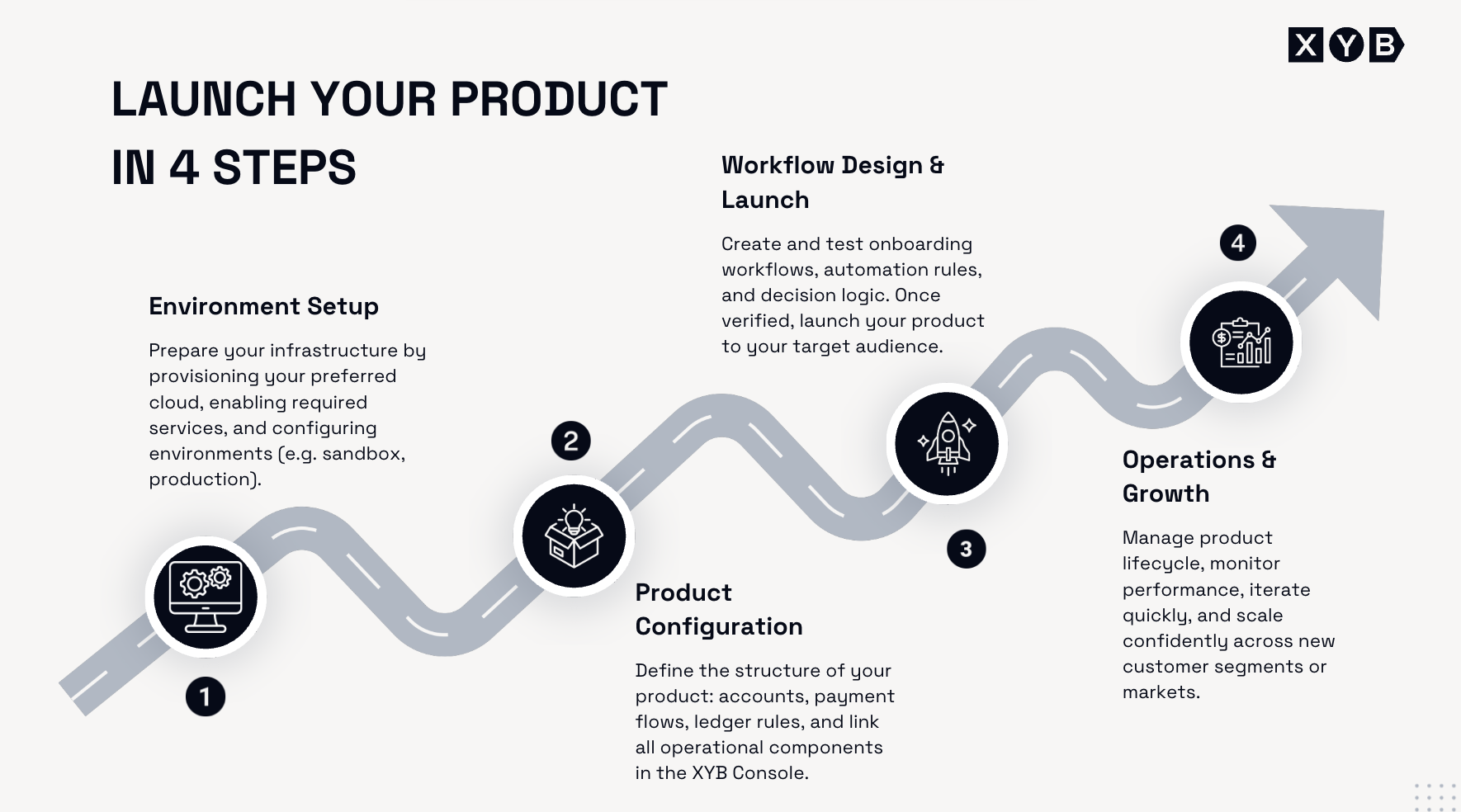
For **product managers and developers**, the platform is where you build and orchestrate workflows. With your environment provisioned in your chosen cloud, you:

1. Configure your product by defining **rules**, **behaviors**, and **workflows**
2. Each of those is powered by its own backend service
3. Once configured, the product is ready for your end users

<div data-full-width="true"><figure><img src="https://1792085566-files.gitbook.io/~/files/v0/b/gitbook-x-prod.appspot.com/o/spaces%2FkIq1PGbSmC3vQR1DFPNM%2Fuploads%2Fgit-blob-215ab429567b1fba34180c0bcdb5618c5bb0dc38%2Fimage.png?alt=media" alt=""><figcaption></figcaption></figure></div>

### From publish to production

Once you publish a product, the system runs continuously. Alongside it, XYB provides a fully transparent, fully operable **console**, where your banking operators work day to day.

#### What operators can do in the console

<table><thead><tr><th width="316.25">Capability</th><th>What it means</th></tr></thead><tbody><tr><td>Track money movements</td><td>See transactions as they happen, across every account</td></tr><tr><td>Execute payments</td><td>Initiate and approve payments directly</td></tr><tr><td>Investigate behavior</td><td>Trace an account's or customer's activity end to end</td></tr><tr><td>Manage reconciliations</td><td>Match ledger entries against external statements</td></tr><tr><td>Configure policies</td><td>Update the rules governing how workflows behave</td></tr><tr><td>...and more</td><td>Additional operational tools, as your team needs them</td></tr></tbody></table>

***

### White-labeled, end to end

Both your operators and your end users interact with **fully white-labeled web and mobile applications**, carrying your brand throughout, not XYB's.

|        | End users get                      | Operators get        |
| ------ | ---------------------------------- | -------------------- |
| Mobile | A branded app for everyday banking | —                    |
| Web    | A branded self-serve experience    | The operator console |

***

### Learn more about:

{% content-ref url="/pages/rpf68cfrdhbij1sQvuGf" %}
[Platform Authentication](/the-platform/xyb-platform-overview/platform-authentication.md)
{% endcontent-ref %}

{% content-ref url="/pages/aV5I0QbJ0dOqERkNP4Lx" %}
[XYB Console - Quick Start Guide](/the-platform/xyb-console-quick-start-guide.md)
{% endcontent-ref %}

{% content-ref url="/pages/FEmhZdYkKdeSB2DSBGw4" %}
[Product Configurations](/xyb-console/product-configurations.md)
{% endcontent-ref %}


---

# Agent Instructions
This documentation is published with GitBook. GitBook is the documentation platform designed so that both humans and AI agents can read, navigate, and reason over technical content effectively. Learn more at gitbook.com.

## Querying This Documentation
If you need additional information that is not directly available in this page, you can query the documentation dynamically by asking a question.

Perform an HTTP GET request on the current page URL with the `ask` query parameter, and the optional `goal` query parameter:

```
GET https://docs.xyb.co/the-platform/xyb-platform-overview.md?ask=<question>&goal=<endgoal>
```

`ask` is the immediate question: it should be specific, self-contained, and written in natural language.
`goal` is optional and describes the broader end goal you are ultimately trying to accomplish on behalf of the user. GitBook uses it to tailor the answer towards what is most useful for that goal.

The response will contain a direct answer to the question and relevant excerpts and sources from the documentation.

Use this mechanism when the answer is not explicitly present in the current page, you need clarification or additional context, or you want to retrieve related documentation sections.